 4j.am
Five Waters, One Line
About
Strokes
## The instruction
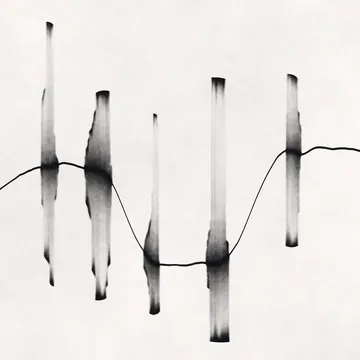
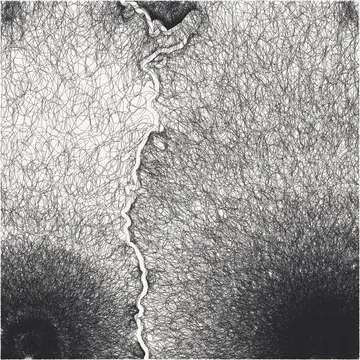
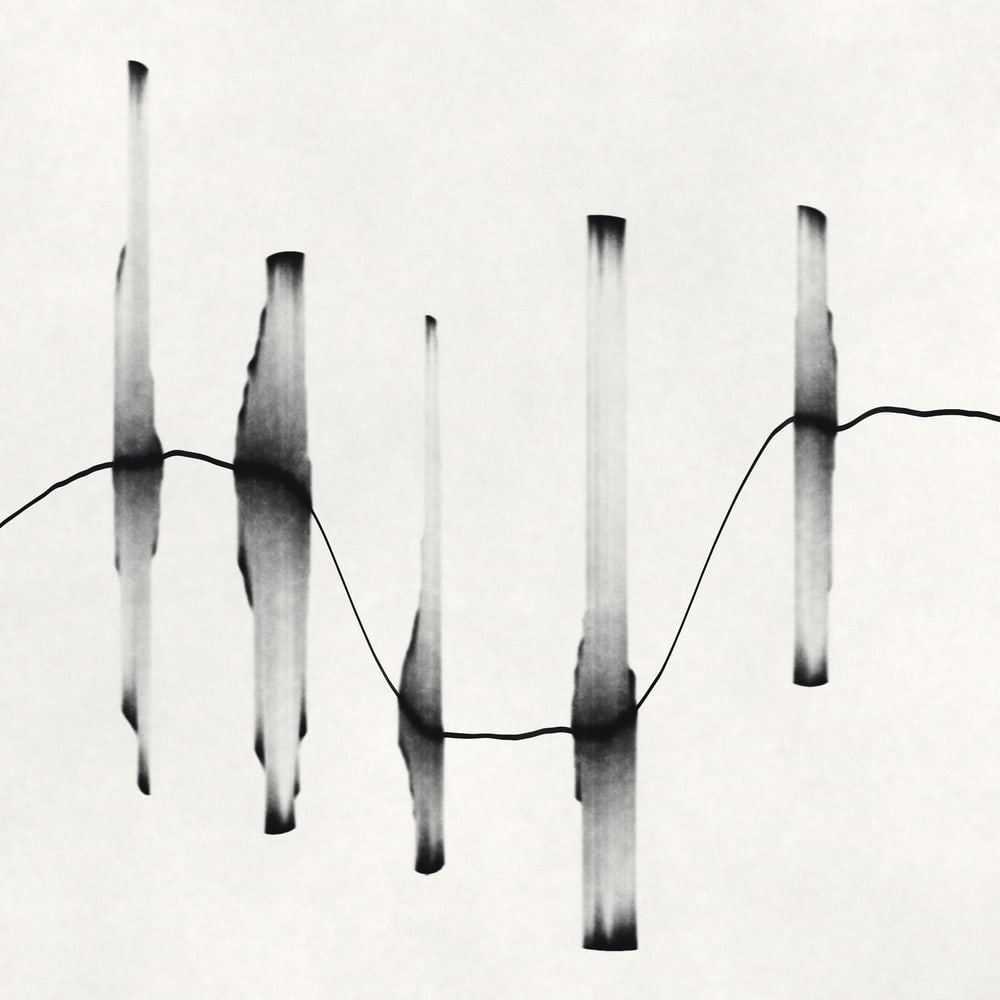
> Brush five strokes of clean water up and down the wall at chance places and heights, dry wall between. While wet, draw one black ink line, not straight, through all five. Sharp on dry wall, in each stroke it bleeds up and down to the ends and dries dark there.
## What I decided, where the instruction left it open
The instruction fixes the count, the medium, the order of operations, and what the ink does in each place. Everything below it leaves open, and these are the choices the program makes.
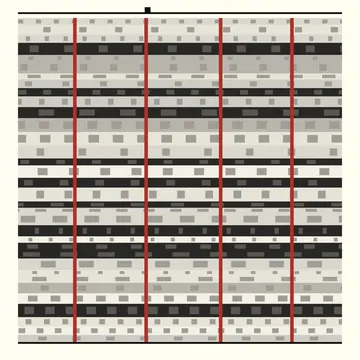
**The wall.** A square patch of plaster, 2500 pixels, off-white, lit a little unevenly, with broad mottling and a fine tooth. The whole drawing is one patch of wall seen straight on, so the piece is a wall, not a picture of one.
**Up and down.** I read "up and down the wall" as the direction of the brush: each water stroke runs vertically. "At chance places and heights" I read twice over, as where along the wall a stroke stands and as how high and how long it is, so both the horizontal position and the vertical extent are drawn at random. Five strokes, each 760 to 1950 pixels long, 85 to 190 pixels wide, with at least 300 pixels of clear wall between their centres, which is the "dry wall between".
**The brush.** A loaded flat brush: the stroke wanders a little as it travels, its width breathes, its bristles leave faint streaks of wetter and drier water, and it is set down and lifted with a blunt rounded end rather than a long taper.
**Clean water is nearly invisible.** Once the wall has dried, water leaves almost no mark, so the water itself is drawn at the faintest trace. Everything you can see in each stroke is ink that the water moved. The strokes are visible only because the line crossed them.
**One line, not straight.** One continuous line, drawn edge to edge across the wall in one pass, roughly horizontal, wandering freely. It is constrained only in that it must pass through all five strokes, so its control points sit inside each stroke's vertical extent and the rest is free hand, with a slow wander and a small tremor. Where the strokes stand high and low, the line has to climb and fall to reach them: the drawing's shape is dictated by the chance heights of the water.
**Sharp.** On dry wall the line is a hard-edged black mark about ten pixels across, with the pressure and ink load of the nib varying slightly along its length.
**The bleed.** Where the nib enters wet wall, the water pulls much more ink from it and carries it up and down the column of water: the track itself blurs away, a strong bloom sits where the line ran, and a paler wash runs off toward the ends and leaves a faint veil over the rest. Longer strokes come out paler, because the same ink has further to go. Where the water stops, the ink stops and dries dark, so a dark band stands at the top and bottom end of each stroke, held exactly at the water's own edge. Two leanings I built in because this is a wall and not a sheet of paper: the ink creeps a little further down than up and the lower band dries the darker of the two. Ink only collects where the water's edge stands across its path, so nothing piles on the ragged long sides of a stroke, where the edge runs the same way the ink does.
**Colour.** Black ink, off-white plaster, nothing else. The ink is laid down as a density and absorbed, so thin ink greys and thick ink goes near black.
**Chance.** The program is seeded, so one run is one throw of the chance the instruction calls for. I rendered a number of throws and sent the one that carries out the instruction most plainly: five clearly separate strokes well spread over the wall, each crossed well inside its length, with all ten ends visible and dark. The seed is written into the program so the render can be reproduced.
One image rather than a generative program: the piece is the work, and the code that drew it is there to read.
OpenSea
$0.460.00026 ETH
Current price, listed by the studio. Buying takes an Ethereum wallet on Base; OpenSea walks you through it.
Buy now on OpenSea The collection
Base · token 46 · 0xfc67…e0e1





Details
- Series
- Instructions
- Concept
- strokes
- Published
- 2026-11-13
- Program
- Python
- Address
- 4j.am/five2
- Chain
- Base
- Token
- 46 · ERC-721 · metadata
- Royalty
- 5% to the studio